Sleeping fruit bats

Sleeping golden-capped fruit bats look so snug with their wings wrapped around their bodies. Perhaps it’s because their wings are huge. They are the largest bats in the world and when their wings are stretched out… their wingspan is as wide as I am tall. Imagine a colony of thousands of them: the sound of their wings beating through the air as they take flight at dusk.

20161112_141839
Golden-capped fruit bats

They are found only in the Philippines and in the 1920s colonies of 150,000 individuals were reported (probably of a mix of species). Their numbers have plummeted. The total population of golden-capped fruit bats is now estimated to be around one or two percent of what it was 200 years ago: possibly no more than 20,000 individuals.

As night falls, the bats leave their roosting sites in search of fruit to feed on. Figs are a favourite and they may fly as far as 30 kilometres in search of them. Fruit bats play an important role in the forest dispersing seeds and as pollinators.

Click on the image to download a golden-capped fruit bat colouring page:
fruitbats_colouring

Golden-capped fruit bat (Acerodon jubatus) further information:

Colour a tamaraw

They may resemble domesticated carabao (water buffalo) but tamaraw are a different species and the most endangered buffalo species. Classed as critically endangered, they are found only on the island of Mindoro in the Philippines.

Tamaraw have distinctive V-shaped horns and a shaggy coat of chocolate to ebony fur. Adults stand four feet tall and weigh an average of 300 kilograms.

Click on the picture below for a pdf to print and colour:

tamaraw

October is Tamaraw Month, find out more about these special little buffaloes:

Hope has horns (WWF Philippines)

Tamaraw (Ultimate Ungulates)

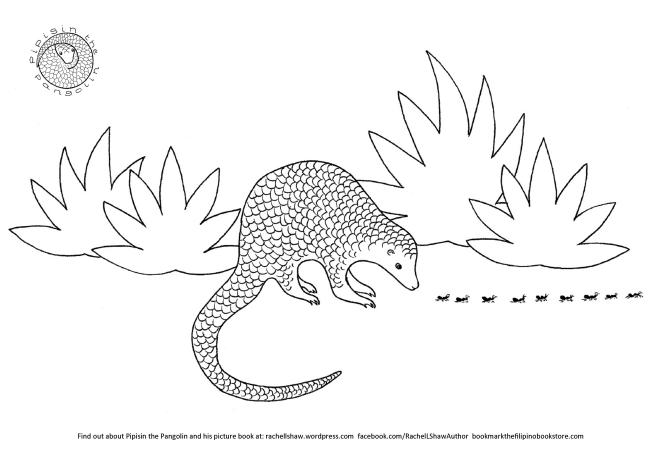
Colour in a pangolin

There are eight species of pangolin in the world: four in Asia and four in Africa.

Asian pangolins:

  • Chinese
  • sunda
  • Indian
  • Philippine

African pangolins:

  • long-tailed or black-bellied
  • tree or white-bellied
  • cape or Temminck’s ground
  • giant ground

Pangolins feed on ants and termites. They can eat 70 million ants a year, collecting them up with their very long sticky tongues. They don’t have any teeth but, once inside the stomach, the ants and ground up with stones.


Click on the picture below to open a printable pdf:

pangolin colouring


front cover
Pipisin the Pangolin picture book