Sleeping fruit bats

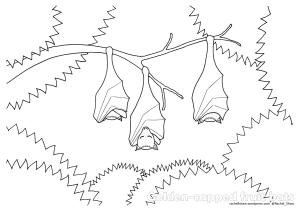
Sleeping golden-capped fruit bats look so snug with their wings wrapped around their bodies. Perhaps it’s because their wings are huge. They are the largest bats in the world and when their wings are stretched out… their wingspan is as wide as I am tall. Imagine a colony of thousands of them: the sound of their wings beating through the air as they take flight at dusk.

20161112_141839
Golden-capped fruit bats

They are found only in the Philippines and in the 1920s colonies of 150,000 individuals were reported (probably of a mix of species). Their numbers have plummeted. The total population of golden-capped fruit bats is now estimated to be around one or two percent of what it was 200 years ago: possibly no more than 20,000 individuals.

As night falls, the bats leave their roosting sites in search of fruit to feed on. Figs are a favourite and they may fly as far as 30 kilometres in search of them. Fruit bats play an important role in the forest dispersing seeds and as pollinators.

Click on the image to download a golden-capped fruit bat colouring page:
fruitbats_colouring

Golden-capped fruit bat (Acerodon jubatus) further information:

Diwa the Dugong – coming soon

My brand new picture book will be out in a few weeks. It’s published by Bookmark in the Philippines to raise awareness of dugongs. I’ve been working with Reynante ‘Rey’ Ramilo from Community Centred Conservation (C3); an NGO working on dugong conservation in Busuanga, Palawan in the Philippines.

Dugongs once grazed in their thousands on the seagrass meadows of the Philippines including in Manila Bay. But numbers have declined and Palawan is one of their last strongholds in the country. They still face many hazards including entanglement in fishing nets and in the ropes used to farm seaweed. Rey told me that dugongs have no safe haven at the moment and that C3 are advocating the establishment of a dugong sanctuary.

planting-seagrass

Dugongs are also known as sea cows because their diet consists mainly of seagrass. I’ve spent a lot of time planting seagrass to make collages for the book. Diwa’s story is about a dugong whose seagrass meadows are destroyed soil washes into the sea from nearby hillsides that have been cleared of trees.

Diwa must swim away from the place she knows and find somewhere new to live. On her journey she encounters many perils but also receives help from strangers who tell of a place with bountiful seagrasses… a place that would be a prefect sanctuary area for dugongs.

Rey shared with me a legend about dugongs from Busuanga. It’s a bleak and disturbing story but the description of the place inspired my thoughts of a sanctuary area for dugongs:

Once upon a time, there was a poor family that lived in a faraway place on a beach, located at the foot of the mountain, where the forest was wild with the tallest trees, crawling vines and shrubs covering the forest floor. Birds would sing the entire day, and when the day turned to night, the crickets would come out to serenade them.

diwa-cover

Dual langauage in English and Filipino, thanks to Rey for the translation.

Coming out in a few weeks at Bookmark The Filipino Bookstore
For enquiries, email or call at 895-8061 to 65.
marketing@bookmarkthefilipinobookstore.com

Flowers that smell like the dead

My least favourite plant for smell alone is hedge woundwort. It’s related to mint but is really unpleasantly stinky. It makes me shudder just to think about it. Luckily the fetid scent is only released when you crush the leaves. However in the forests of south-east Asia, the scent of Rafflesias have a much-more potent reputation. Named after Sir Thomas Stamford Raffles, Rafflesias are also known as corpse flowers because they smell of rotting flesh. These amazing plants are found only in south-east Asia and amongst the 28 different species are some of the biggest flowers in the world. The largest Rafflesia arnoldii is found on Sumatra, Java and Borneo, and can grow to an impressive 1 metre across.

The smell of the super-sized flowers attracts flies but they’re not being lured to their death. The flies are actually pollinators and transfer pollen from plant to plant. Rafflesias aren’t carnivorous but they are parasites. Their roots spread inside their host vines.

The smallest ‘biggest’ flower in the world is Rafflesia consueloae. It was discovered on a mountainside in Luzon in the Philippines in February 2014. Unlike it’s larger cousins, it smells of coconut!

rafflesia

The collage is life-size with a Philippine 1 peso for scale.

Colour a tamaraw

They may resemble domesticated carabao (water buffalo) but tamaraw are a different species and the most endangered buffalo species. Classed as critically endangered, they are found only on the island of Mindoro in the Philippines.

Tamaraw have distinctive V-shaped horns and a shaggy coat of chocolate to ebony fur. Adults stand four feet tall and weigh an average of 300 kilograms.

Click on the picture below for a pdf to print and colour:

tamaraw

October is Tamaraw Month, find out more about these special little buffaloes:

Hope has horns (WWF Philippines)

Tamaraw (Ultimate Ungulates)